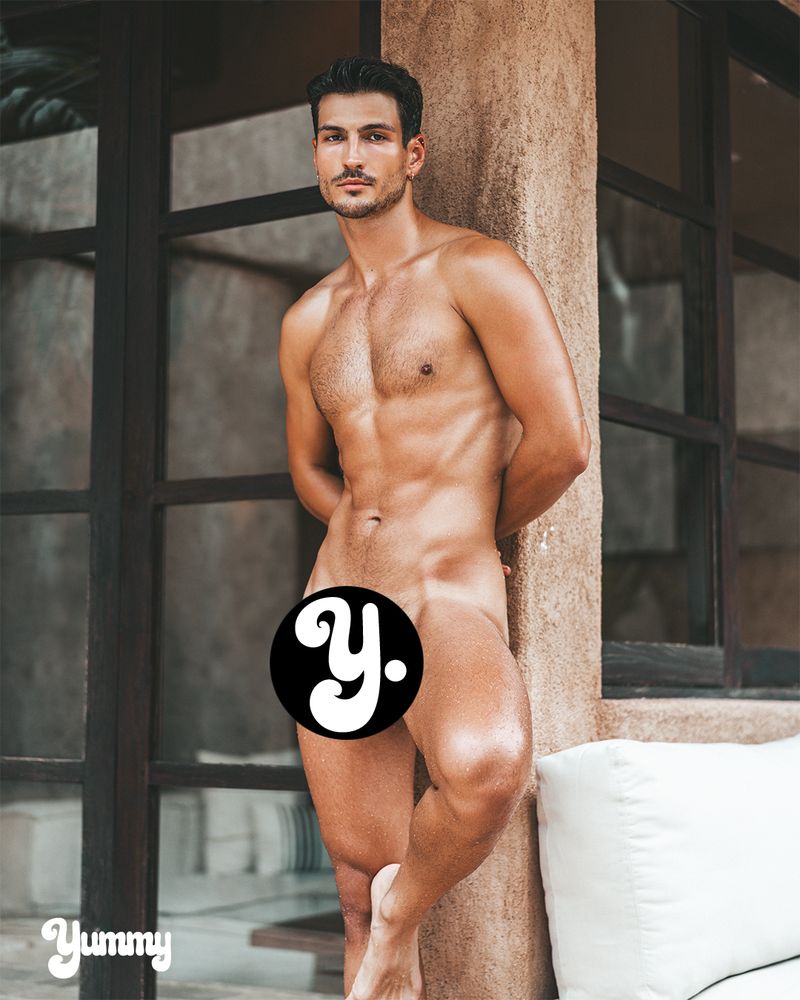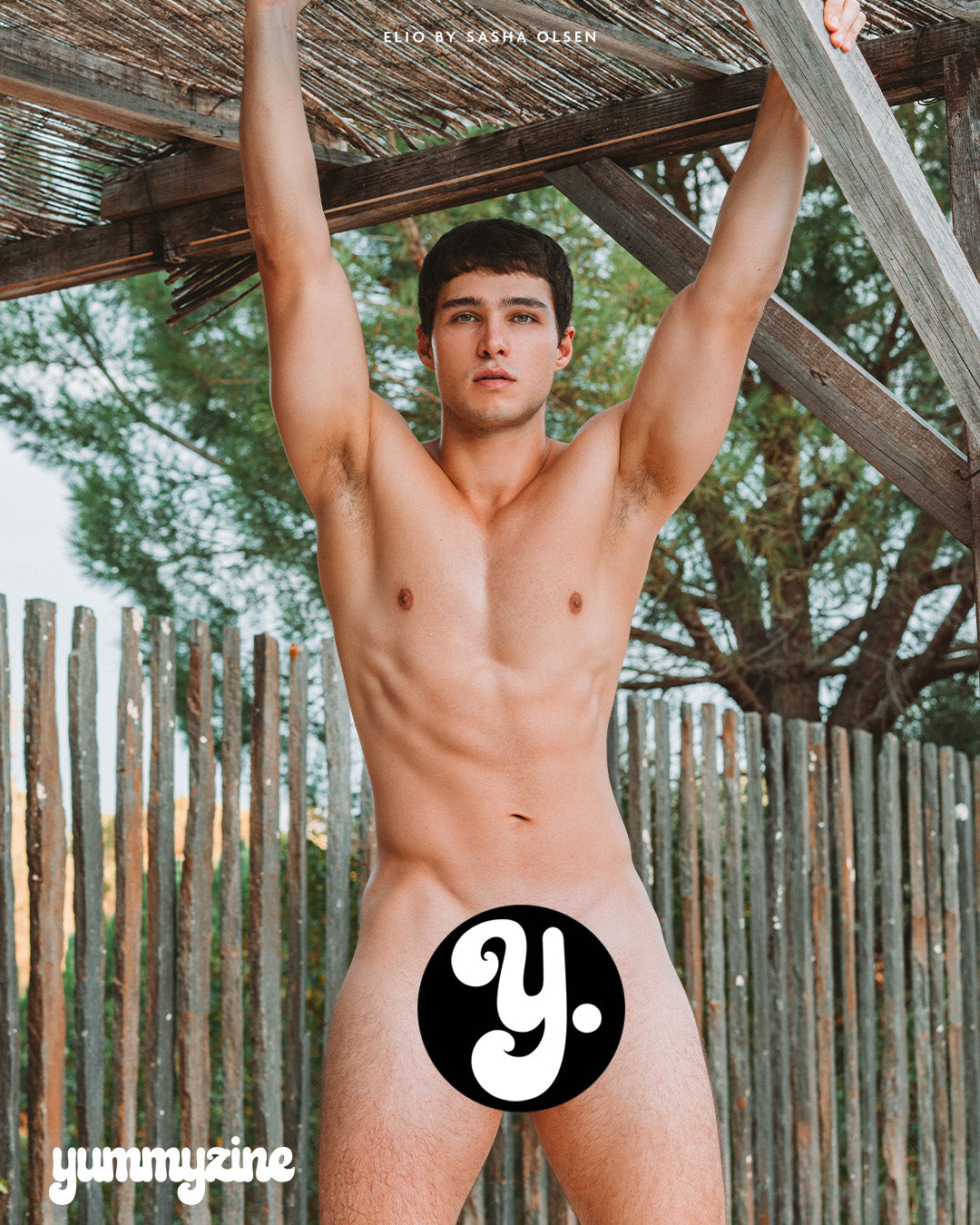



At 24, Ugo Marchal moves through life with a quiet sense of clarity, balancing instinct, discipline, and a deeply personal idea of freedom. Born in Versailles and now rooted in the countryside near Paris, he speaks about silence, ambition, and identity with a calm honesty that feels unforced. Between structured studies and a creative path shaped by intuition, Ugo builds his world somewhere between control and letting go. In this conversation for Yummy 12, he reflects on presence, duality, and the small rituals that keep him grounded—always leaving space for what comes next.
The images are cropped/made safe for online purposes, full images available inside Yummy Issue Twelve
Photo story by sasha olsen, interview by Adrian Gomis Exposito
An Interview with Ugo Marchal
AGE. Who is Ugo when the phone is down, and the music stops? What does your inner world feel like?
UM: I’m 24 years old, and when the phone is put down and the music stops, I’m just someone who’s learned to be at peace with himself. My inner world is calm. Not empty, just calm. I don’t really judge things. Everyone has their own path. Comparing yourself to others doesn’t make much sense to me. I don’t think you have to wait for success to feel “enough.” You already are. Confidence isn’t a reward; it’s more like a starting point. Life is just there to be explored. And you’re the one shaping it.
AGE. You were born in Versailles but chose the countryside near Paris as your home. What is it about the silence of the landscape that nourishes you more than the city?
UM: Versailles gave me an appreciation for beauty. The countryside taught me silence. The city is stimulating, but it can drain you fast. It always wants something from you. Nature doesn’t ask anything. That changes everything. In that silence, things feel clearer. You hear yourself again, what you think, what you actually want. The city shapes you. Silence nourishes you. I’ve chosen what builds me from the inside out.
AGE. You hold a Master’s degree from a business school, yet you’ve carved a path through social networks and creative projects. How do you balance that structured, analytical background with the spontaneity of your current life?
UM: School taught me how to structure things. My networks taught me how to feel. My master’s degree isn’t at odds with what I do. Rigour, analysis, strategy: these are the invisible foundation of every piece of content I create. But creativity can’t be entirely planned. It requires trust. That’s what balance is: thinking like an entrepreneur, acting like a creator. Spontaneity isn’t the opposite of structure; it's what structure unleashes when it’s well-established.
AGE. Music seems to be a constant for you—you’ve said it “amplifies the moments.” If your life right now had a soundtrack, what would it sound like?
UM: Not a genre. A legacy. House music and our parents’ all-time classics. Two worlds telling the same story: the joy of being alive. House is the moment that instant when the sound washes over you. Classics are memory songs that existed before you but still define you. That’s my soundtrack: the energy of what sets you free, the depth of what endures.
AGE. You mentioned that you keep the door open to whatever comes your way. Has there ever been a moment when you almost closed it, only to find something beautiful on the other side?
UM: Yes. There was a time when everything was against me. Everything. I almost closed that door for good. But something inside me chose to fight. Not out of necessity, but out of a refusal to remain ignorant of what lay on the other side. And I found peace, but not the kind you’re given, the kind you earn. To face it is to win. To be ready to fight is to keep it. That door, I’m leaving it open. Always.
AGE. Ambition is often painted as something aggressive or loud, but you describe yourself as a "simple guy" who cherishes peace. How do you reconcile a drive for success with a need for tranquillity?
UM: Loud ambition isn't my style. Mine runs deep. For me, success means listening to myself. Trying everything that truly inspires me, even if it means losing. There is no victory without loss. My only real failure would be telling myself that I didn't give it my all. I approach every experience as a quest, like I’m a video game character but with my own rules. Peace of mind isn’t the opposite of ambition. It’s what allows me to move forward without betraying myself.
AGE. You’ve expressed a very detached view of the future—that if your projects were to stop, it wouldn’t matter because life is full of other opportunities. Where does that sense of security and freedom come from?
UM: This freedom comes from a simple place: I’ve learned to embrace pain. Not to avoid it but to welcome it. When you’re no longer afraid of losing, nothing can hold you back. Losing doesn’t really mean anything; it's always about gaining something else, but it’s something you don’t realise at the time. It usually is a door to a world you would never have explored otherwise. My security doesn’t come from what I have. It comes from what I’ve been through.
Quick-Fire Questions
AGE. A ritual that keeps you steady?
UM: Exercise. No exceptions. It’s my total reset. When everything piles up, when my mind is spinning too fast, I move. My body takes over, and my mind goes quiet. It’s not a routine. It’s a necessity. My anchor. Afterwards, everything is clearer. Always.
AGE. What is the most beautiful thing you’ve seen this week?
UM: Life can come to a halt and start up again. Desire, morale, money, companionship, it's all fleeting. Everything goes away. Everything comes back. Like a boomerang. This week, the countryside landscapes were made even more beautiful by the fine weather. Beauty is simple, free, right there. The best part? Feeling the positivity return. Always. Without exception.
AGE. One thing people often read wrong about you?
UM: Honestly, I don't know, and I don't care. What others think of me doesn't change who I am. I don't base my identity on how others see me. Everyone has their own way of doing things. Mine is to simply be myself fully without trying to be understood by everyone.
AGE. A song that feels like home?
UM: "Creep" by Radiohead. A song about feeling out of place in the world, and which, paradoxically, makes you feel exactly where you belong. There’s something honest about this song. No filters. Just raw emotion, carried by something grand. That’s what home is. Not a place, a feeling.
AGE. Your favourite time of day in the countryside?
UM: The end of the day, without a doubt. It’s time for the verdict on whether you’ve succeeded or not. And no matter the answer, you can lay down your arms. Relaxation isn’t a luxury; it’s the reward. You’ve done your job. All that’s left is to enjoy this brief moment before the next day begins. The countryside at this hour is perfect for that. Everything slows down. You, too.
AGE. What instantly puts you in a good mood?
UM: After a workout. Music is blaring in the car. At that exact moment, your body is warm, your mind clear, and great music is kicking in. Nothing else exists. It’s simple. It’s enough. That’s all.
Unveiling His Yummy Side
AGE. What does the word “yummy” evoke for you? Is it a taste, a look, or an energy?
UM: Yummy feels like a whole era. The 70s and 80s, men in their natural state, unfiltered, simply alive. The body is not sculpted for an algorithm. To me, that is exactly what it is: a raw masculine beauty that needs no justification. An energy you feel before you can even define it.
AGE. The story you shot with Sasha Olsen for Yummy 12 feels really special. How did you feel throughout the experience?
UM: It was a unique moment, professional, intense, and real. On set, a distinct feeling: anything is possible. Indestructible. Unshakable. That’s what this shoot with Sasha is all about: two people giving their all and creating something authentic together.
AGE. Was there a behind-the-scenes moment that stayed with you?
UM: Probably Sasha himself. And his camera. A young man. You don’t expect it. And then you see what comes out of it, and you realise that talent has no age, no predefined form. That’s what makes it unforgettable. Not the setting, not the lighting. The surprise of someone who masters his art in silence. That’s what stays with you.
AGE. You have a very refined, stylish presence. Do you feel more powerful fully dressed in a sharp silhouette or when you’re stripped back to basics?
UM: To me, power is about going unnoticed. No need for flashy clothes. When I’m stripped down to the bare essentials, that’s when I feel strongest. Nothing to hide, nothing to prove. Invincibility isn’t in what you see. It's what you feel when no one is watching.
AGE. There is a specific kind of intimacy in how you share your life online. How do you decide what to let people see and what to keep for yourself?
UM: I have my own rules, and I don’t explain why I live by them. I share who I am. I don’t share what I don’t do and what I never will. It’s as simple as that. No artificial filters, no putting on a show. Just alignment between what I live and what I show. The boundaries I set online are the same as the ones I live by. That’s what integrity is.
AGE. What’s the most seductive thing someone can do without touching you?
UM: Someone who fights in silence. Without waiting for help. Without seeking recognition. Just with their head down and their resolve unshaken.
AGE. What is something subtle someone can do to catch your eye across a crowded room?
UM: Someone who doesn't need to be noticed. Paradoxically, that's the only thing that really catches my eye. Not an outfit, not a calculated smile. Just someone who is fully present, without trying to charm the room. That independence from the gaze of others, in a crowded room, is visible from a distance.
AGE. What’s your favourite underwear for a daily routine? Do you have a "special occasion" go-to?
UM: Casual chic, that's my everyday philosophy. Not too much, not too little. Something that strikes a balance between effort and nonchalance. You can tell it’s put together without it being too obvious.
AGE. Are you a slow-burner who likes to build tension, or do you prefer the heat to hit all at once?
UM: Both. Depending on what the moment calls for. Sometimes the tension that builds slowly—that silence that settles in and says it all without saying a word. Sometimes the immediate intensity—when it’s obvious, why wait? I don’t force either one. I read the moment. And I live it to the fullest.
A Final Note
AGE. When you look at the horizon of your life five years from now, what is the feeling you hope to have achieved? What version of Ugo are you moving toward?
UM. In five years? I have no idea. And that’s exactly why I’m moving forward. Not toward a fixed goal, but toward a discovery. Free and fulfilled. That’s the only goal I set for myself. The rest, I’ll find along the way.