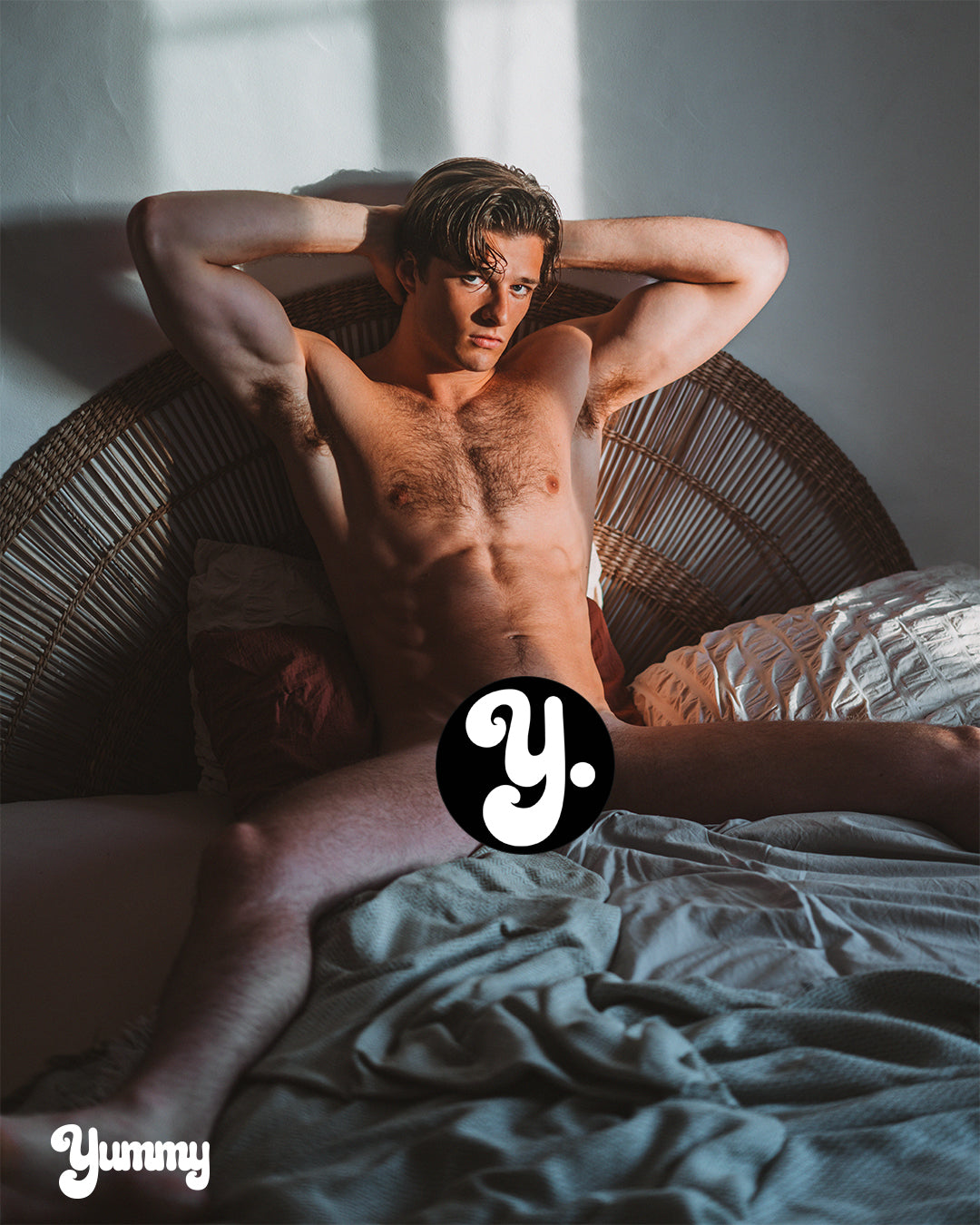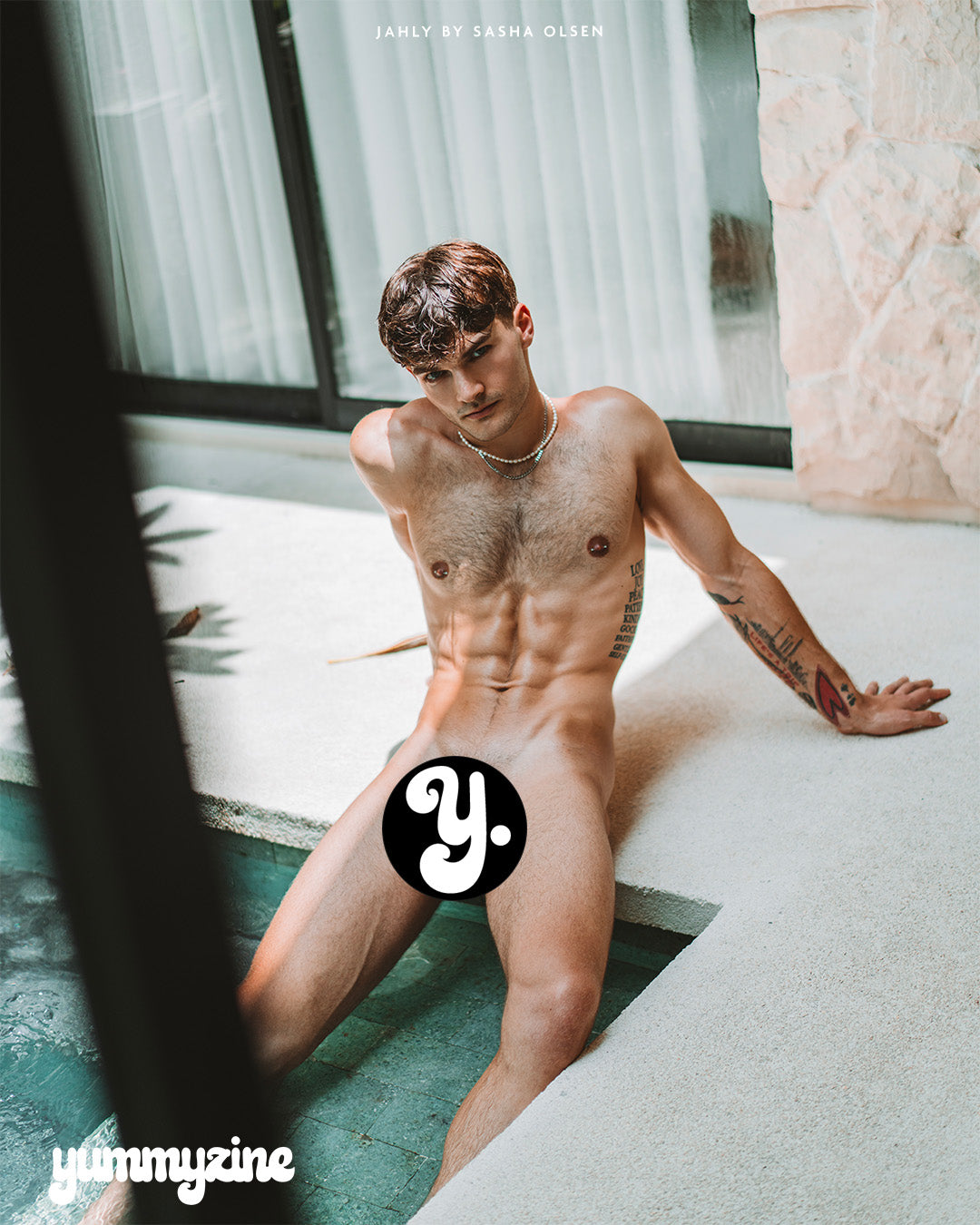



Born in Sicily and shaped by years of constant movement across Europe, Elio exists between structure and sensitivity, strategy and instinct. His path, from medicine to design, theatre, luxury marketing, and modelling, has never followed a straight line. Instead, it has been defined by transformation: an ongoing process of questioning, rebuilding, and learning how to feel at home within himself. For Yummyzine 11, Elio opens up about instability, intimacy, masculinity, creativity, and the emotional weight of being truly seen. What emerges is the portrait of someone deeply self-aware, constantly evolving, and unwilling to compromise on authenticity.
The images are cropped/made safe for online purposes, full images available inside Yummyzine Issue Elveven
Photo story by sasha olsen, interview by Adrian Gomis Exposito
An Interview with Elio
AGE. To begin, introduce yourself in your own way. Who is Elio today, and how does Sicily still live inside you?
E. My name is Elio, which actually comes from Aurelio. I’m a 28-year-old Sicilian, although today I honestly struggle to define myself in a simple way. I couldn’t really tell you exactly what I do or where I’m heading, because over the last few years, so many things in my life have changed. What I can say is that I’m someone who refuses to compromise on who I am, someone who is trying to live by truly listening to himself. Sicily was a beautiful place to grow up. In some ways, it felt like living inside a glass bell jar, protected, intense, and deeply authentic. It gave me the chance to experience a side of life and reality that you often cannot find in larger cities. I always carry Sicily with me, but when I think about it, I think more about Mount Etna than the sea. It was always a fixed point in the landscape that reminded me where I was in the world. Then, moving away for studies and work, I slowly had to learn how to live without that external reference point. I had to stop looking up at the horizon for answers and start finding those points of stability within myself instead.
AGE. Your path has been anything but linear, from medicine to design, from Italy to the rest of Europe. When did you first realise you needed a different life than the one you initially imagined?
E. I believe it’s incredibly difficult for a person to truly choose who they are within the timeframes society expects from us. We are often asked to decide our future at an age that simply cannot define the rest of our lives. I’ve never regretted the choices I made, and I’ve never regretted changing them either. Everything shaped me in some way. Maybe the difference between me and someone with a more linear path is that I’ve always questioned myself. I’ve never accepted anything as fixed. I constantly revisit my decisions and ask whether what felt right years ago still feels right today. And I’ve always allowed myself the freedom to change as I naturally change as a person. It’s not about inconsistency, but about being open to transformation. I’m still the same person, but no longer the person I used to be. The more I experience life, the more I understand myself, and the clearer my direction becomes. I begin to recognise the natural path I’m meant to follow. As I grew older, work also stopped being something that had to define me. Instead, it became something that should support the kind of life I want to build.
AGE. Milan was your first major departure. What did that city give you, and what did it take from you? What made you come back to it?
E. Milan has been central to my life, probably even more than Sicily, in terms of shaping my mindset and identity. It’s a city that gives a lot and takes a lot. My relationship with it has always felt like a dysfunctional family relationship; I knew it could make me feel good and hurt me at the same time. What Milan took from me was my illusion of things; it forced me to open my eyes to how the real world works. I came back after a period away because it felt like a fixed point in the middle of the ocean. Returning felt emotional, almost like being embraced by streets that still belonged to me. But even if Milan is home, I don’t think it is ultimately my place in the world.
AGE. You’ve lived in Scotland, Barcelona, Amsterdam, Munich, and now Milan again. How has constant movement reshaped your sense of home? Do you adapt to each city, or is there a core that remains untouched?
E. For a long time, I didn’t really feel at home anywhere. Today, I realise home is deeply connected to the possibility of building habits and meaningful relationships, a routine that feels emotionally positive. Out of all those places, Barcelona is where I felt most at home, where I could picture a life naturally aligned with who I am. I think my core remains the same, but I imagine it through colours. My personal essence might be green, and every city carries its own colour. When they meet, they create a new shade. I don’t feel like I become a different person; I feel like I've expanded. Each place allowed me to discover another side of who I already was.
AGE. You studied design and interior design, fields deeply connected to space. How do physical environments influence your emotions and identity?
E. I strongly feel that spaces affect the way I experience situations and even the people I share those environments with. I’m a very organised person; I don’t like chaos, and I’m naturally drawn to symmetry. When I’m in a space that aligns with my perception of balance and light, I feel more at ease and capable of letting myself go. I also believe that spaces reveal a lot about people; it’s not about being expensive or aesthetically perfect, but about the atmosphere that exists there. To me, spaces act almost like an echo chamber of the people who create them.
AGE. Luxury marketing brought you into a more strategic world. How do creativity and structure coexist in you?
E. It’s an ongoing struggle. For a long time, I pushed aside my creative side because I was afraid society wouldn't accept it, so I tried to strengthen my analytical side instead. There were periods where I completely immersed myself in creativity, especially after leaving medicine. Then later on I shifted almost entirely toward the strategic and analytical world through my master’s studies and corporate work in luxury marketing. Today, I feel I’ve finally found a balance where there’s no real winner or loser in that internal conflict.
AGE. Over the last few years, you’ve changed cities five times. What has instability taught you about yourself?
E. Over the last few years, changing cities so many times taught me that I’m far stronger than I probably give myself credit for. It made me realise that I’m someone deeply open to change and naturally capable of adapting. Curiosity has always been the force pushing me forward. Every new city and every new environment became an opportunity to explore not only the place itself, but also myself within it. Instability forced me out of my comfort zone again and again. It taught me how to adapt to unfamiliar situations while still protecting myself. The more my environment changed, the more I wanted to experience new situations, because I genuinely enjoy discovering myself.
AGE. Sport is not optional for you. What does physical effort give you, and how does it balance your love for food and pleasure?
E. Sport is a form of care and love for myself. Training is an investment in the only place I will truly live in forever: my body. It’s not about appearance or being superficial; I can nurture both my mind and my body. I’m a very intense person, and I tend to indulge deeply in things, so sport became the balance that allows me to do that without losing myself. When I was younger, I also struggled with my relationship with food and with my body. Sport taught me to take care of myself rather than punish myself.
AGE. Theatre has played an important role in your life. What did it teach you about presence and being seen? Do you feel closer to yourself on stage or in everyday life?
E. Theatre taught me how to stay present and fully experience the moment. It made me understand that we are not only a physical body, but also perception. I learned how to stand in my own presence and reveal myself without hiding, facing my real identity without wearing a mask. At this stage, I feel closest to myself in everyday life. I no longer feel the need to perform a character the way you do on stage or in front of a camera. The expectations I live with today are mostly my own, and because of that, I feel more authentic.
Quick-Fire Questions
AGE. A city that changed you more than you expected?
E. Amsterdam.
AGE. A habit that keeps you grounded no matter where you are?
E. Going to bed early.
AGE. Something you protect fiercely about yourself?
E. I never truly expose my personal life to anyone who isn’t very close to me.
AGE. Early mornings or late evenings?
E. Early mornings.
AGE. What does the colour green represent for you?
E. Safeness.
AGE. One thing you miss when you move on from a place?
E. Knowing the city instinctively instead of relying on GPS.
Unveiling His Yummy Side
AGE. When you hear the word “yummy,” what kind of energy does it evoke for you?
E. Probably a slightly silly energy. Being contacted and chosen for a creative project by people who invest their trust in you is always an incredible feeling. The experience itself was genuinely positive, especially because of the people I met. Sasha was someone with whom I can honestly say I still share a friendship today.
AGE. You did a stunning photoshoot for Yummyzine 11. Was there a moment from the shoot that stayed with you?
E. What stayed with me most was the first place we shot, overlooking the sea and surrounded by nature. It gave me an incredible sense of peace and freedom; I felt exactly where I was supposed to be. Another funny moment was shooting near the pool while people were working nearby. I felt slightly embarrassed because, despite working on explicit projects sometimes, in real life, I’m actually a very discreet person.
AGE. Is attraction, for you, something intellectual, physical, or emotional first?
E. It starts more from energy and presence than pure physical appearance. Of course, there are physical traits I like, like well-kept hands, a gentle but awake gaze, but I’m not looking for perfection. Then comes the emotional connection. I’m drawn to open, attentive people who place humanity first. I truly like simple and genuine people.
AGE. What type of underwear do you use daily, and which one makes you feel sexier?
E. I usually wear both boxers and briefs. It’s honestly more about comfort than feeling sexy, but if I had to choose, I’d probably say I feel sexier wearing briefs.
AGE. Do you feel more seductive when you’re fully in control, or when you let yourself be vulnerable?
E. I feel most seductive when I’m completely in control, or when I consciously allow myself to let go of that control. I’m always very aware of myself and the situation I’m in. Very rarely in my life have I allowed myself to be truly vulnerable, and I think that’s something I still need to work on.
AGE. What can we find at your bedside table?
E. You could probably find my phone charging there and my sleeping gummies, because I’m honestly obsessed with them. They feel like my final little act of comfort before falling asleep.
AGE. Do you enjoy being observed, or only when you choose to be seen?
E. Over the years, I’ve worked a lot on my relationship with being seen. After experiencing bullying when I was younger, my greatest wish was to disappear into the crowd. With time, I began to understand the power of presence. Do I like being looked at? Yes, I think I do. Ironically, I feel more comfortable being observed when I haven’t consciously chosen it, because when I actively want attention, I probably become less authentic.
AGE. Is intimacy something you enter slowly, or do you trust instinct?
E. I’m very careful about whom I allow into my intimacy. I do trust my instinct, but my instinct usually tells me to stay attentive. I remain open and warm while still protecting myself. I think the more negative experiences you go through emotionally, the harder it becomes to fully let go without caution.
AGE. After dark, what feels most indulgent: conversation, movement, theatre, or disappearing into the city?
E. Probably conversation. Being able to truly talk with someone for hours is one of the clearest signs of real connection. It’s beautiful to have people to have fun with, but if you can’t simply talk together, then something important is missing.
A Final Note
AGE. Looking forward, what version of yourself are you slowly moving toward, emotionally, creatively, and physically?
E. I’ve realised I need to give more space to my own eyes and perceptions, and the only way I can do that is through creativity and exploring my emotions without filtering them. I’m moving toward a version of myself that feels more aligned, honest, and free. A version of me that no longer needs to choose between structure and sensitivity, or stability and exploration, but can finally allow all those parts to coexist naturally.